When a university adopts an AI policy today, the content almost always revolves around the same questions: May students use ChatGPT for assignments? How does the examination office detect AI-generated submissions? What rules apply to oral exams? That focus is understandable — teaching and academic integrity are the core mission of any higher education institution. Yet a comprehensive analysis by the German Higher Education Forum on Digitisation (HFD) reveals that an entire domain has been systematically overlooked: university administration.
30 Policies, 16 Federal States — and a Conspicuous Gap
In May 2026, the HFD published its “Guidelines Check 2026” — a comparative analysis of 30 officially published AI guidelines drawn from all 16 German federal states. The study, produced by the CHE Centre for Higher Education Development, paints a nuanced picture of progress: AI policies are becoming more common, more detailed, and more legally aware. But a pattern stands out.
The HFD describes AI guidelines as “enabling documents”: texts that do not merely regulate, but also contextualise and inspire. Well-crafted guidelines, the analysis argues, give university members orientation in an environment that is changing technologically and legally faster than any statute can keep pace with.
Among the identified blind spots — alongside accessibility and ecological resource consumption — university administration is explicitly named. Almost all documents examined address teaching staff and students. Administrative processes such as campus management, examination organisation, document management, or secretarial work barely feature.
Why This Gap Matters
Administration is the backbone of any university. Without well-functioning processes in examination management, enrolment, or data governance, even the most innovative teaching cannot run smoothly. And it is precisely here that AI holds significant potential — but also significant risk when no clear rules exist.
Consider examination registration: in many institutions, staff manually verify whether a student meets the prerequisites for a given exam — a time-consuming and error-prone process. AI-assisted systems can perform these checks automatically and consistently. But who bears responsibility when the algorithm errs? Which data may the system access? How long are decision logs retained?
Or take document management: universities handle thousands of sensitive records — transcripts, applications, examination papers. AI can help classify documents, monitor deadlines, and reduce processing times. But without clear guidelines, key questions remain open: Which AI tools are GDPR-compliant? Who is authorised to deploy these systems, and who is not?
The silence of current guidelines on these issues is not a niche problem. It means that administrative staff make consequential decisions every day without institutional backing — creating legal uncertainty and blocking meaningful efficiency gains.

The EU AI Act Raises the Stakes
The HFD analysis also points to the EU AI Act, which has imposed binding requirements on AI deployment since 2025. Universities using AI in administration must classify the relevant systems, document their use, and in certain cases implement specific safeguards. Institutions that fail to address this operate in a regulatory grey zone.
Systems that automatically decide on admissions or examination eligibility may fall under the AI Act’s “high-risk” profile — with corresponding documentation and transparency obligations. An AI policy that excludes administration provides no guidance here.
What Universities Should Do Now
The HFD’s report concludes with a call for AI guidelines to be designed dynamically — not as static documents, but as living frameworks that evolve alongside technological development. This applies all the more to administration.
In practical terms: universities should expand their existing guidelines with a dedicated section on AI in administration. This section should define which processes may be AI-supported, which data protection and transparency requirements apply, and how staff will be qualified to work with AI tools.
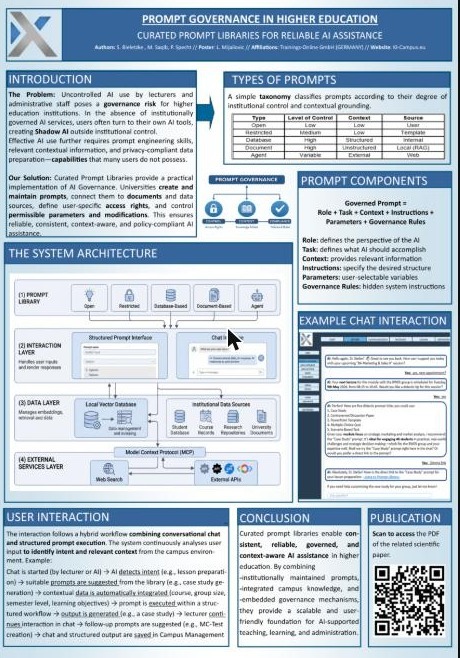
Campus management systems such as TraiNex — which digitally map examination organisation, attendance tracking, and document management — can play a structuring role in this context. They establish the database foundation on which AI can operate sensibly and compliantly, provided the institutional framework is in place. TraiNex goes further: it can selectively anonymise data and uses GDPR-compliant AI models integrated directly into its processes, ensuring that sensitive data never leaves the controlled environment of the campus management system.
Conclusion
The Higher Education Forum on Digitisation has delivered an important stocktaking with its Guidelines Check 2026. The finding is clear: German higher education has made progress in strategic AI integration over the past two years — but administration has been left behind. It is time to correct that.
The pattern is not new. An empirical survey conducted in 2023 as part of a publication on AI maturity already showed that teaching is penetrated by AI significantly faster than administration. In the AI Maturity Matrix for Higher Education, many institutions are still best described as “AI Teaching Experimenters” — universities that teach about AI use. Attaining the status of “AI Process Professional” — an institution that has systematically integrated AI into administrative processes — remains the exception.
→ Workshop materials on the AI Maturity Matrix — freely available
→ Full HFD report: “AI Guidelines in Check 2026” (in German)