The RAGI Model: Classifying AI Applications in Higher Education and Campus Management

Artificial intelligence is entering universities in many forms — sometimes strategically planned by management, sometimes through spontaneous individual initiatives. Students use chatbots for learning support, administrators experiment with automated workflows, and faculty integrate adaptive systems into their courses. Yet amid this diversity, a shared conceptual framework for systematically classifying these applications has been missing. The RAGI Model addresses precisely this gap.
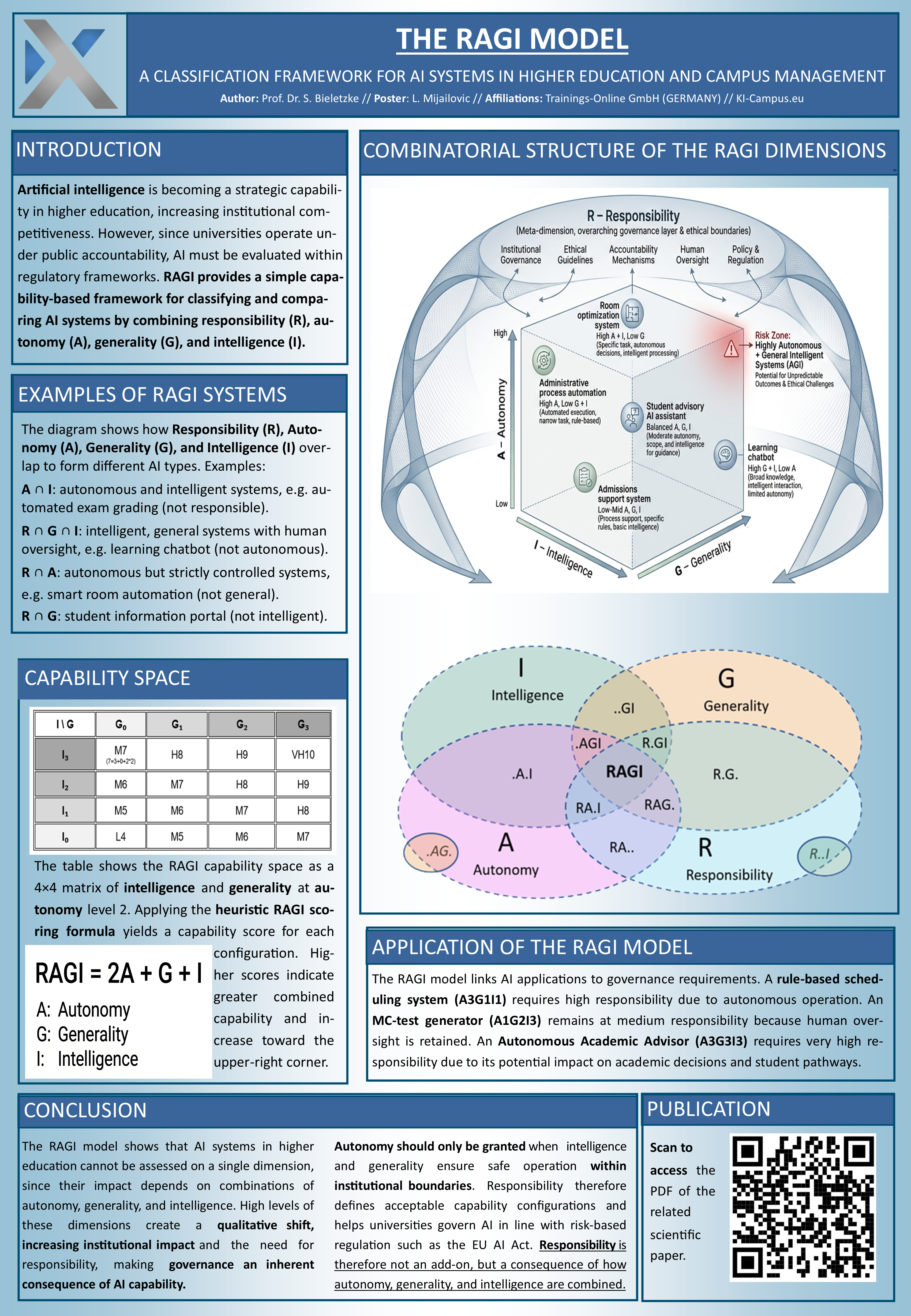
The RAGI Model — AI classification framework for universities
The RAGI Model — AI classification framework for universities (click to enlarge)

Why Universities Need a Different Approach

Companies can take a technology-first approach to AI: implement new workflows, then evaluate them within regulatory frameworks. Public institutions such as European universities face the opposite challenge — they must consider AI systems within the context of institutional responsibility from the very start, without knowing in advance what technological capabilities will emerge.

This challenge is compounded by the fact that AI systems are increasingly evolving from isolated assistance tools into generalized, partially autonomous applications. Until now, no established conceptual framework has systematically classified different AI systems in the higher education context.

Four Dimensions of the RAGI Model

Dr. Stefan Bieletzke of Trainings-Online GmbH presented the RAGI Model at the 18th International EDULearn Conference in Palma (June 2026) — a classification framework for AI systems built on four dimensions:

  • R – Responsibility: A meta-dimension capturing institutional governance and ethical oversight
  • A – Autonomy: To what extent does the system act independently?
  • G – Generality: Is the system task-specific or broadly applicable?
  • I – Intelligence: How complex is the system’s cognitive performance?

The three capability dimensions (A, G, I) define a space in which any AI application can be positioned. Responsibility acts as a governance overlay across this space.

Examples from Campus Life

  • Room optimization systems combine autonomy and intelligence without generality. They act independently, but within a narrowly defined domain.
  • Learning chatbots combine generality and intelligence but lack autonomy. They handle a wide range of questions, but always wait for user input.

These distinctions matter enormously for institutions: a highly autonomous, general intelligent system (AGI) carries different risks than a specialized assistant — and demands correspondingly different governance measures.

Responsibility as a Governing Principle

The RAGI Model explicitly asks whether certain combinations of capability dimensions should be limited on grounds of institutional responsibility — particularly those leading to highly autonomous and general intelligent systems. Campus management systems such as TraiNex today handle examinations, admissions, documents, and communication. As AI becomes more deeply integrated into these processes, a framework like RAGI becomes indispensable for meeting requirements around transparency, traceability, and accountability.

Conclusion

The RAGI Model offers a simple yet extensible dimensional framework that links the technical capabilities of AI systems with their institutional application context. It enables structured comparison across AI applications — and its relevance extends well beyond higher education. For decision-makers at educational institutions, it provides the conceptual foundation to plan AI investments purposefully and deploy them responsibly.
→ Read the full paper on ResearchGate (EDULearn 2026)

Governing AI Prompts at the Institutional Level: New Paper by TraiNex at EDULearn 2026

How can a university ensure that AI tools are used reliably, pedagogically meaningfully, and consistently — even by staff without prompt expertise? This question was at the heart of a paper presented by researchers from Trainings-Online GmbH and TH OWL at the 18th international EDULearn Conference in July 2026 in Palma.

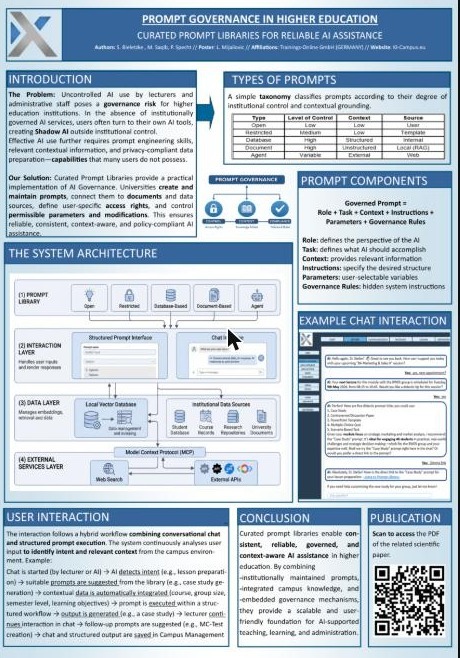
Conference poster: Prompt Governance in Higher Education (EDULearn 2026)
Conference poster from EDULearn 2026 — click to enlarge

The paper “Prompt Governance in Higher Education: Curated Prompt Libraries for Reliable AI Assistance” introduces a curated prompt library as a governance approach — directly integrated into a campus management system. Rather than leaving AI usage to chance, universities can centrally manage prompts, control target audiences, and monitor usage.

The system distinguishes five prompt types: from freely editable prompts to database-based queries to agent-driven workflows that autonomously conduct literature searches in external databases. Embedded in a campus chat assistant, the system identifies the user’s intent and automatically selects suitable prompts — including contextual enrichment from module handbooks and course schedules.

The approach demonstrates: reliable AI in higher education does not require complex infrastructure — it requires smart integration into existing systems like TraiNex.

→ Read the full paper on ResearchGate

Can AI Understand Emotions? Empirical Quality Assessment of Sentiment Analysis in the SMARTA Project

Can an AI reliably detect whether a student is frustrated, motivated, or indifferent? This question was at the heart of our empirical study, presented at the EDULEARN25 conference in Palma de Mallorca in July 2025.

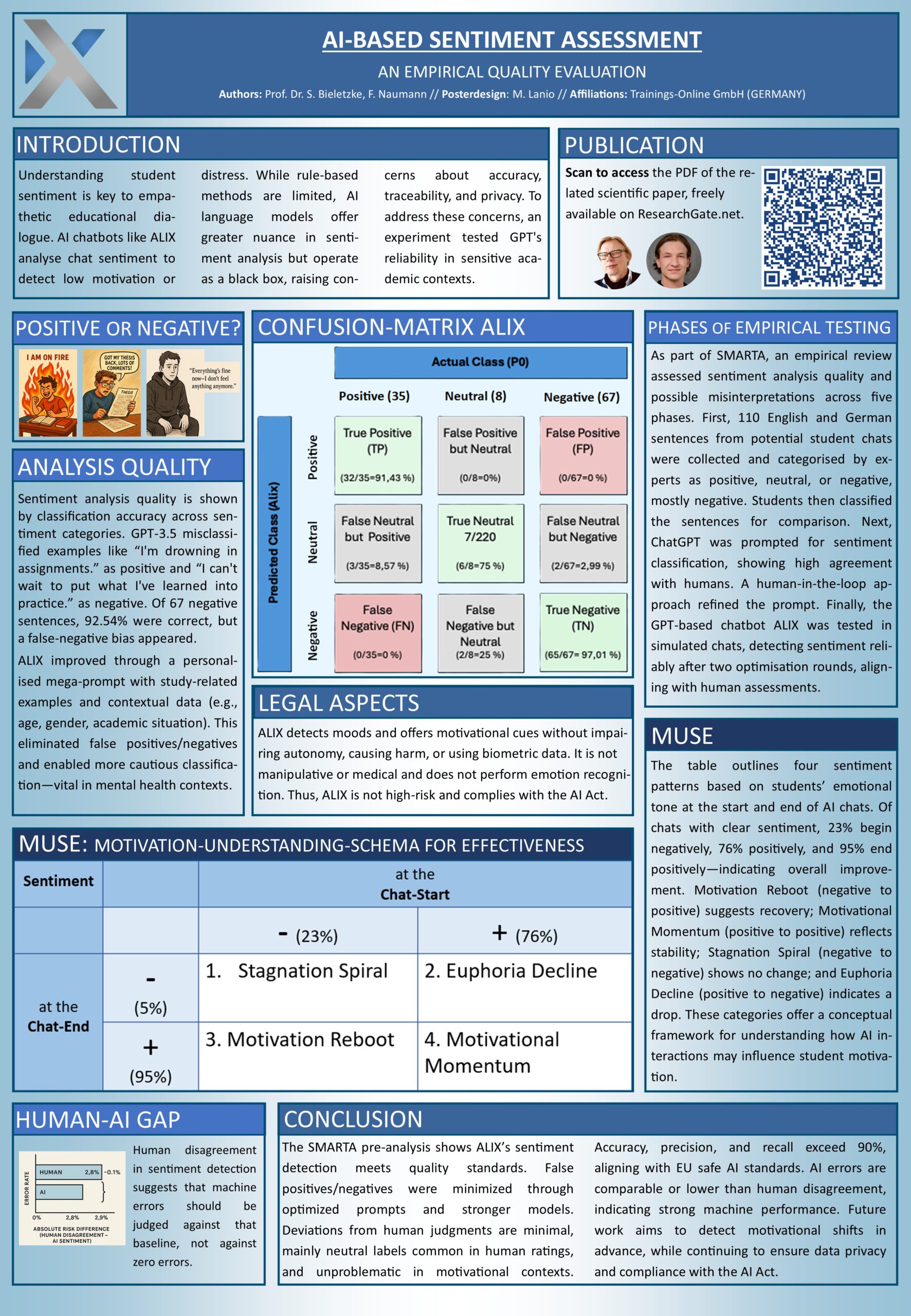
Sentiment Analysis Poster – SMARTA Project EDULEARN 2025
Sentiment Analysis: AI vs. Human — click to enlarge

Sentiment analysis as a core component of SMARTA

In the SMARTA project, we develop AI-powered chatbots that support students with motivation, learning organization, and personal challenges. For the chatbots to respond empathetically to procrastination, social pressure, or frustration, they need to accurately detect the emotional tone of conversations. That is where automated sentiment analysis comes in.

What the study examined

In a comparative study, sentiment classifications by linguistic experts, students, and various GPT models (including GPT-3.5 and newer versions) were analysed. Quality metrics included accuracy, precision, recall, and confusion matrices.

Result: GPT more reliable than expected

Even older models like GPT-3.5 recognise sentiment with high reliability. Deviations occur primarily in neutral statements — an area where human assessments also diverge. This led us to propose the Human-AI-Gap-Benchmark: AI performance should be measured relative to human error rates, not against a zero-error ideal.

Legal context: EU AI Act

Sentiment analysis remains a black-box process with limited explainability. We assessed the method for compliance with the EU AI Act. Our solution: sentiment results are stored anonymously, and the chat history is deleted immediately after each conversation ends. In the SMARTA project, sentiment analysis is deployed as a trusted module.

→ Full paper on ResearchGate