Our vision: Smart university assistances, which as dialogic AI indispensably enrich the university experience and work efficiency for both students and staff in daily operations
Interested? Watch the video and read about SMARTA or SMart-C.
This blog reports on AI in campus management. That includes the question of where AI reaches its limits – and where proven rules are the better solution. Because behind the gloss of the new technologies lurks an uncomfortable question: for many core processes at universities, classic algorithmic intelligence is not just sufficient — it is simply better.
By algorithmic intelligence we mean deterministic, rule-based procedures: a clearly defined input is processed according to explicit rules and reproducibly leads to a uniquely determined result. Learning AI systems, by contrast, derive their results from patterns in training data and work probabilistically, producing a likely result.
Which kind of intelligence fits which problem in higher education?
“We solve the problems with AI,” some startups promise. It sounds modern, progressive, future-proof. No wonder AI shows up more and more often in university strategies and IT roadmaps. But as so often, reality is more complex: after the peak of inflated expectations about AI and the trough of disillusionment comes the plateau of productivity. And on that plateau it becomes clear which kinds of problems can be solved with language models and which are better solved with algorithmic rule intelligence (algorithms, for short).
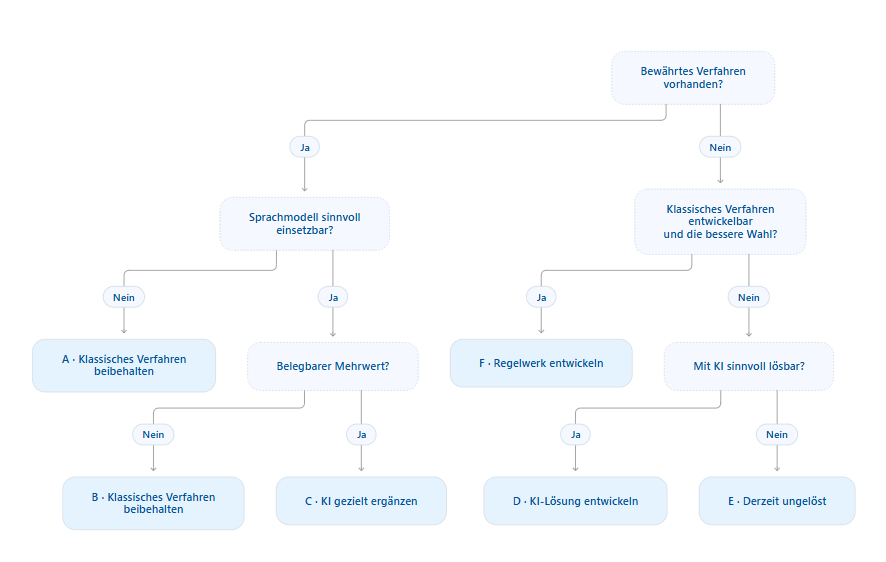
Roughly five cases can be distinguished:
A) Problems that are already solved with algorithms and that language models could NOT solve (rule task, classic)
B) Problems that are already solved with algorithms and that language models could NOT solve better (rule task, advantageous)
C) Problems that are already solved with algorithms and that language models could solve better (rule-to-AI task, added value)
D) Problems that CANNOT be solved with algorithms but that language models could solve (AI task, new)
E) Problems that CANNOT be solved with algorithms and that language models could NOT solve either
Established campus management systems have long had field-tested solutions for A and B. For them, AI becomes exciting above all for C and D. Some startups, on the other hand, advertise with “We do it with AI.” That can be misleading in two ways: not every task is solved better by AI. And sometimes “with AI” merely means that someone had the classic rule set programmed via vibe coding.
A decision logic for introducing AI-based solutions could look like this: Is there already a rule set that reliably fulfills the task? Then there needs to be a concrete need for improvement before a language model can even be considered as a replacement. If there is no solution yet, one should first check whether a clear rule set can be developed. Only when the task involves open language, unstructured information or patterns that are hard to put into rules does a learning model become particularly interesting. And even then, its benefit must be measured against the concrete result.
In other words: AI in the sense of machine learning and deep neural networks is a powerful tool for problems in which patterns have to be recognized in large amounts of data, language has to be understood or complex relationships have to be approximated. But not every problem is an AI problem. And not every “clever” solution has to be a learning AI solution. No – a proven rule set can be the better solution: simpler, more transparent and more reliable. Where no rule set exists yet, it is even worth checking whether one can be developed – before deploying a language model.
A weighted average grade according to the examination regulations is a mathematically fully defined problem. Weightings, rounding and pass thresholds are fixed. The result can be determined exactly and reproducibly with a calculation procedure. There is exactly one correct answer — and it can be calculated exactly with an algebraic procedure.
Using an AI model here that “learns” from past grading would not only be unnecessarily costly. It would simply be wrong: a model would introduce noise into the calculation where mathematical exactness is required. A grade of 2.3 under the examination regulations (on the German scale from 1.0 to 5.0) is 2.3 — not an estimate, not an approximation. Not to mention that new examination regulations with a new grade calculation would first require generating a large amount of training data.
Systems like TraiNex deliberately rely on algorithmic intelligence here: the rules of the examination regulations are coded exactly, and the calculation is deterministic and fully traceable at any time. New examination rules can be integrated quickly. For examination offices and accreditation bodies, traceability is not optional — it is mandatory.
Early warning systems for dropout risk are a popular field of application for AI. A model could analyze exam results, attendance and other data to produce a risk assessment.
First, however, it must be clear what task the system is supposed to fulfill. Is it about identifying, according to defined criteria, a reason to offer support? Then a rule-based warning system can be the superior solution: if a student has failed three exams and, at the same time, their attendance rate drops below 50 %, an alert is triggered — transparent, traceable, explainable. The rule is known, can be defined by the university itself, and its application can be fully documented.
If, on the other hand, the goal is to predict future dropouts as accurately as possible, that is a different task. AI prediction models can be better here, because it is about changing patterns in large amounts of data. But why the model flagged a student as a “dropout risk” cannot easily be explained — and that is delicate both in terms of data protection law and ethics. Especially with personal risk predictions, the requirements for transparency, traceability and data protection rise.
May this student register for this exam? Have they completed the prerequisites, are they in the right semester, are all required coursework components in place? This, too, is not an AI problem. It is a rule-checking problem.
The eligibility requirements are precisely defined in the examination regulations — and an algorithm can apply these rules to thousands of registrations within seconds. Eligibility rules are configured per degree program or federal state, every registration is checked against them, and rejections are communicated with a justification. If errors occur, the rule set can be adjusted quickly and safely.
An ML model that “learns” from past eligibility decisions would not only introduce unnecessary complexity here — and with it unnecessary energy consumption and unnecessary costs. It would also carry the risk of reproducing historical injustices or making wrong decisions that cannot be explained and may not hold up legally.
The regulatory perspective is also interesting: the EU AI Act classifies certain AI systems in education as high-risk systems — among other things, when they decide on access or admission or evaluate learning outcomes. Where the examination regulations already specify clear rules, a deterministic algorithm can be not only simpler and more accurate, but also considerably less problematic from a regulatory point of view.
The mistake does not lie in using AI — it lies in using it indiscriminately. AI is powerful when training data is available, when patterns are to be recognized that humans cannot grasp, when language needs to be understood, or when large amounts of unstructured data need to be analyzed.
Classic algorithms are superior when the problem is mathematically fully defined, when exactness is required, when traceability is legally or ethically necessary — and when data protection and transparency are the priority.
For campus management systems, this means: grade calculation and the application of clearly defined eligibility rules belong in the hands of rule-based procedures. An early warning alert based on defined criteria can be implemented the same way. AI can complement these where it brings a demonstrable advantage — for example in understanding freely worded advisory requests or in an individual learning dialogue. And for all the problems where proven rule-based procedures do not deliver a good solution, the use of language models should be considered.
This categorical thinking can help when deciding for or against AI. As a professional, however, you should then reconnect the categories, because in the medium term the combination of rule set and language model is likely to be particularly promising. The SMARTA architecture, for example, uses the “Algorithmic Prompt Composer (APC)”, which controls a language model in a rule-based way with database access and then processes its response according to rules. Classic loops with termination conditions are also a good framework for keeping AI agents running.
The question is not whether to use AI. The question is where it really helps — and where an existing or newly developed rule set is the better solution, or whether AI brings more risk than benefit. Universities that understand this difference make better technology decisions. And they build systems that students, teachers and accreditors can trust.
If a rule is enough, you don’t need a language model. When rules reach their limits, AI can show its strengths. Being modern does not mean building AI in everywhere. Being modern means solving the problem correctly. Sometimes with AI, sometimes without AI, sometimes in combination with a rule. And only those who know the world of rule-based algorithms can also solve a university’s problems sensibly with AI.
This blog covers AI in campus management. That includes the question of where AI reaches its limits — and where proven rules are the better solution. Behind the shine of new technology lurks an uncomfortable question: for many core processes at higher education institutions, classic algorithmic intelligence isn’t just sufficient — it is simply better.
By algorithmic intelligence we mean deterministic, rule-based methods: a clearly defined input is processed according to explicit rules and reproducibly leads to one clearly defined result. Learning AI systems, by contrast, derive their output from patterns in training data and work probabilistically, arriving at a likely result.
Which kind of intelligence fits which higher-education problem?
“We solve problems with AI” is the pitch of many a startup. It sounds modern, forward-looking, future-proof. No wonder AI keeps turning up more often in university strategies and IT roadmaps. But, as so often, reality is more complicated: after the peak of inflated expectations and the trough of disillusionment comes the plateau of productivity. And on that plateau it becomes clear which kinds of problems language models can actually solve — and which are better solved with algorithmic rule-based intelligence (algorithms, for short).
Five broad cases can be distinguished:
One decision logic for introducing an AI-based solution could be: Is there already a set of rules that reliably performs the task? Then a concrete need for improvement has to exist before a language model is even considered as a replacement. If no solution exists yet, the first step should be to check whether a clear set of rules can be developed. Only once the task involves open-ended language, unstructured information, or patterns that are hard to formalize does a learning model become genuinely interesting. And even then, its benefit has to be measured against a concrete result.
In other words: AI in the sense of machine learning and deep neural networks is a powerful tool for problems where patterns in large volumes of data need to be recognized, language needs to be understood, or complex relationships need to be approximated. But not every problem is an AI problem. And not every “clever” solution has to be a learning AI solution. A proven set of rules can be the better solution: simpler, more transparent, and more reliable. Where no set of rules exists yet, it is even worth checking whether one can be developed — before deploying a language model.
A weighted grade point average calculated under examination regulations is a mathematically fully defined problem. Weightings, rounding, and pass thresholds are fixed. The result can be determined exactly and reproducibly with a computational procedure. There is exactly one correct answer — and it can be calculated exactly with an algebraic method.
Using an AI model here that “learns” from past grading would not just be unnecessarily complex. It would simply be wrong: a model would introduce noise into a calculation that demands mathematical exactness. A grade of 2.3 under the examination regulations is 2.3 — not an approximation, not an estimate. Not to mention that a new set of examination regulations with a new grading formula would first require generating a large volume of training data.
Systems like TraiNex deliberately rely on algorithmic intelligence here: the examination regulations are encoded exactly, the calculation is deterministic, and it remains fully traceable at any time. New examination rules can be integrated quickly. For examination offices and accrediting bodies, traceability isn’t optional — it’s mandatory.
Early-warning systems for the risk of dropping out are a popular field for AI. A model could evaluate exam results, attendance, and other data to produce a risk assessment.
But first it has to be clear what task the system is meant to perform. Is it about flagging, by defined criteria, an occasion for a support offer? A rule-based warning system can be the superior solution here: if a student has failed three exams and attendance falls below 50 percent at the same time, a flag is triggered — transparent, traceable, explainable. The rule is known, can be defined by the institution itself, and its application can be fully documented.
If, instead, the goal is to predict future dropouts as accurately as possible, that is a different task. AI forecasting models can do better here, because it is about shifting patterns across large datasets. But why the model flagged a particular student as a “dropout risk” is not easily explained — and that is sensitive both under data protection law and ethically. Especially with personal risk predictions, the requirements for transparency, traceability, and data protection rise sharply.
May this student register for this exam? Have the prerequisites been met, are they in the right semester, are all the required coursework credits on file? This, too, is not an AI problem. It is a rule-checking problem.
Admission requirements are defined exactly in the examination regulations — and an algorithm can apply these rules to thousands of registrations every second. Admission rules are configured per degree program or state, every registration is checked against them, and rejections are communicated with a reason. If an error is found, the rule set can be adjusted quickly and safely.
A machine-learning model that “learns” from past admission decisions would not only introduce unnecessary complexity here, along with unnecessary energy consumption and unnecessary cost. It would also risk reproducing historical injustices or making decisions that are neither explainable nor, in some cases, legally defensible.
The regulatory angle is worth noting too: the EU’s AI Act classifies certain AI systems in education as high-risk — among other things, when they decide on access or admission, or evaluate learning outcomes. Where examination regulations already set out clear rules, a deterministic algorithm can be not only simpler and more accurate, but also far less problematic from a regulatory standpoint.
The mistake isn’t using AI — it’s using it indiscriminately. AI is powerful when training data is available, when patterns need to be recognized that people can’t easily perceive, when language needs to be understood, or when large volumes of unstructured data need to be evaluated.
Classic algorithms are superior when a problem is mathematically fully defined, when exactness is required, when traceability is legally or ethically necessary — and when data protection and transparency are the priority.
For campus management systems, that means: grade calculation and the application of clearly defined admission rules belong in the hands of rule-based methods. An early-warning flag based on defined criteria can be implemented the same way. AI can add value where it brings a demonstrable advantage — for instance, in understanding freely worded advising requests, or in an individual learning dialogue. And for every problem where proven rule-based methods don’t offer a good solution, deploying a language model is worth considering.
This kind of categorical thinking can help when deciding for or against AI. As a practitioner, though, you should then reconnect the categories — because in the medium term, the combination of rules and language models is likely to be especially promising. TraiNex’s own SMARTA architecture, for example, uses an “Algorithmic Prompt Composer (APC)” that steers a language model on a rule basis with database access, and then processes its response by rules as well. Classic loops with exit conditions are also a good scaffold for keeping AI agents running reliably.
The question isn’t whether to use AI. The question is where it truly helps — and where an existing or newly developed rule set is the better solution, where it brings more risk than benefit. Institutions that understand this distinction make better technology decisions. And they build systems that students, faculty, and accreditors can trust.
If a rule is enough, you don’t need a language model. If rules reach their limits, AI can show its strength. Being modern doesn’t mean building AI into everything. Being modern means solving the problem correctly — sometimes with AI, sometimes without it, sometimes combined with a rule. And only those who know the world of rule-based algorithms can also use AI to solve a university’s problems in a meaningful way.
Saturday evening, 10 p.m. Jonas wants to study. He’s on the university’s website, wondering whether the part-time degree program also accepts applicants with vocational training instead of a high school diploma. No one answers the phone. The email would have to wait until Monday. And the neighboring university’s tab is just one click away.
This is the exact moment a university wins or loses a prospective student. AI-powered chatbots close this gap — around the clock, multilingual, and grounded in reliable institutional information.
The trend is real and accelerating. In 2025, HTW Berlin’s AI chatbot for student services was recognized as a best-practice example by the Hochschulforum Digitalisierung (Germany’s Higher Education Forum for Digitalization). The bot runs GDPR-compliant on the university’s own servers, answering questions about deadlines, documents, and contact persons around the clock — without requiring student services staff to intervene.
AI chatbots in study counseling aren’t a replacement for human advisors — or are they? Good AI chatbots don’t just deliver fast, reliable initial information. On one hand, they handle the same recurring baseline questions — admission requirements, class scheduling, application deadlines — giving human advisors back the time they actually need for complex individual cases. On the other hand, with a solid and up-to-date knowledge base, a chatbot can do even more: engage with an applicant’s specific life situation, communicate in their language, work through details patiently, and suggest alternative degree programs available at the institution.
Many applicant chat solutions are built as standalone systems. As an integrated platform, TraiNex takes a different approach: the applicant chat is not an add-on — it’s a native part of the campus management system. This means the chatbot always knows, without any manual upkeep, when and where a degree program starts, whether it runs as part-time, full-time, or distance learning, and whether spots are still available in the selection process. In addition to context drawn from the campus management system, the chatbot also draws on the university’s linked information pages to generate answers — no duplicate data maintenance, no synchronization issues. When something changes on the university website — for example, in the program curriculum — the chat picks it up automatically.
Proven particularly effective in practice: the chat responds in German, English, Chinese, Turkish, and many other languages — switching automatically when a question is asked in a different language. The application link appears exactly when it fits naturally into the conversation. Or applicants can have a summary of the conversation sent to them, so they can pick it up later or reach out to a human advisor when they’re ready.
The question of whether to invest in AI chatbots for study counseling is no longer relevant — it’s a question of how. Universities that integrate early and close to their core systems benefit on two fronts: they reduce the workload on their advising staff and strengthen their digital presence with prospective students who expect a modern, instantly responsive first point of contact, available 24/7.
When a university adopts an AI policy today, the content almost always revolves around the same questions: May students use ChatGPT for assignments? How does the examination office detect AI-generated submissions? What rules apply to oral exams? That focus is understandable — teaching and academic integrity are the core mission of any higher education institution. Yet a comprehensive analysis by the German Higher Education Forum on Digitisation (HFD) reveals that an entire domain has been systematically overlooked: university administration.
In May 2026, the HFD published its “Guidelines Check 2026” — a comparative analysis of 30 officially published AI guidelines drawn from all 16 German federal states. The study, produced by the CHE Centre for Higher Education Development, paints a nuanced picture of progress: AI policies are becoming more common, more detailed, and more legally aware. But a pattern stands out.
The HFD describes AI guidelines as “enabling documents”: texts that do not merely regulate, but also contextualise and inspire. Well-crafted guidelines, the analysis argues, give university members orientation in an environment that is changing technologically and legally faster than any statute can keep pace with.
Among the identified blind spots — alongside accessibility and ecological resource consumption — university administration is explicitly named. Almost all documents examined address teaching staff and students. Administrative processes such as campus management, examination organisation, document management, or secretarial work barely feature.
Administration is the backbone of any university. Without well-functioning processes in examination management, enrolment, or data governance, even the most innovative teaching cannot run smoothly. And it is precisely here that AI holds significant potential — but also significant risk when no clear rules exist.
Consider examination registration: in many institutions, staff manually verify whether a student meets the prerequisites for a given exam — a time-consuming and error-prone process. AI-assisted systems can perform these checks automatically and consistently. But who bears responsibility when the algorithm errs? Which data may the system access? How long are decision logs retained?
Or take document management: universities handle thousands of sensitive records — transcripts, applications, examination papers. AI can help classify documents, monitor deadlines, and reduce processing times. But without clear guidelines, key questions remain open: Which AI tools are GDPR-compliant? Who is authorised to deploy these systems, and who is not?
The silence of current guidelines on these issues is not a niche problem. It means that administrative staff make consequential decisions every day without institutional backing — creating legal uncertainty and blocking meaningful efficiency gains.

The HFD analysis also points to the EU AI Act, which has imposed binding requirements on AI deployment since 2025. Universities using AI in administration must classify the relevant systems, document their use, and in certain cases implement specific safeguards. Institutions that fail to address this operate in a regulatory grey zone.
Systems that automatically decide on admissions or examination eligibility may fall under the AI Act’s “high-risk” profile — with corresponding documentation and transparency obligations. An AI policy that excludes administration provides no guidance here.
The HFD’s report concludes with a call for AI guidelines to be designed dynamically — not as static documents, but as living frameworks that evolve alongside technological development. This applies all the more to administration.
In practical terms: universities should expand their existing guidelines with a dedicated section on AI in administration. This section should define which processes may be AI-supported, which data protection and transparency requirements apply, and how staff will be qualified to work with AI tools.
Campus management systems such as TraiNex — which digitally map examination organisation, attendance tracking, and document management — can play a structuring role in this context. They establish the database foundation on which AI can operate sensibly and compliantly, provided the institutional framework is in place. TraiNex goes further: it can selectively anonymise data and uses GDPR-compliant AI models integrated directly into its processes, ensuring that sensitive data never leaves the controlled environment of the campus management system.
The Higher Education Forum on Digitisation has delivered an important stocktaking with its Guidelines Check 2026. The finding is clear: German higher education has made progress in strategic AI integration over the past two years — but administration has been left behind. It is time to correct that.
The pattern is not new. An empirical survey conducted in 2023 as part of a publication on AI maturity already showed that teaching is penetrated by AI significantly faster than administration. In the AI Maturity Matrix for Higher Education, many institutions are still best described as “AI Teaching Experimenters” — universities that teach about AI use. Attaining the status of “AI Process Professional” — an institution that has systematically integrated AI into administrative processes — remains the exception.
→ Workshop materials on the AI Maturity Matrix — freely available
→ Full HFD report: “AI Guidelines in Check 2026” (in German)
From 2 August 2026, further key provisions of the EU AI Act apply. Does this affect us as a university? Do we now need to have our AI tools reviewed? What happens if we do nothing? The short answer: it very much depends on what you do with AI. The longer answer is here.

Anyone who interacts with an AI system must in principle be able to recognise that they are dealing with AI. A chatbot for students or a digital assistant should therefore identify itself clearly as an AI system at the latest at the beginning of the conversation – unless this is already obvious.
For universities, this means above all:
Since February 2025, institutions have been required to offer measures to promote the AI competence of their staff. From August 2026, compliance with this obligation can be more strictly monitored.
A specific certificate is not required. However, the following are advisable:
When using generally available AI tools privately, students are normally neither providers nor operators within the meaning of the AI Act. They are, however, protected as data subjects. If a university uses AI for admissions, examination assessment or examination monitoring, obligations arise for the university.
Teaching staff are likewise neither providers nor operators within the meaning of the AI Act. However, they must comply with the university’s requirements, data protection law, copyright law and examination regulations. In order to assess the use of AI in these areas, participation in further training is necessary.
At TraiNex, we assess every AI function based on its specific purpose and impact.
AI-supported search functions, text suggestions, summaries and general chatbots assist users without themselves making decisions about admissions, grades or sanctions. These risk classes are largely permitted without issue.
The picture may look different when an AI result is used directly for consequential decisions. An automatic evaluation of attendance data, for example, is to be assessed differently if examination eligibility is derived from it without further review.
That is why we specifically examine:
AI agents do not form a separate risk category in the AI Act. Here too, what matters is which tasks they take on.
An agent that prepares documents, transfers information or proposes changes for approval is to be assessed differently from an agent that independently rejects admissions, changes grades or sanctions individuals. The latter would be too autonomous and too risky under the AI Act. To achieve an acceptable and permitted risk class, at minimum human approval would be mandatory.
At TraiNex AI agents, we therefore rely on:
Universities and educational institutions should now:
From 2 August 2026, transparency, labelling and documented accountability will become more important for universities above all. Next milestone: the comprehensive high-risk requirements for the education sector apply from 2 December 2027.