Artificial intelligence is entering universities in many forms — sometimes strategically planned by management, sometimes through spontaneous individual initiatives. Students use chatbots for learning support, administrators experiment with automated workflows, and faculty integrate adaptive systems into their courses. Yet amid this diversity, a shared conceptual framework for systematically classifying these applications has been missing. The RAGI Model addresses precisely this gap.
Why Universities Need a Different Approach
Companies can take a technology-first approach to AI: implement new workflows, then evaluate them within regulatory frameworks. Public institutions such as European universities face the opposite challenge — they must consider AI systems within the context of institutional responsibility from the very start, without knowing in advance what technological capabilities will emerge.
This challenge is compounded by the fact that AI systems are increasingly evolving from isolated assistance tools into generalized, partially autonomous applications. Until now, no established conceptual framework has systematically classified different AI systems in the higher education context.
Four Dimensions of the RAGI Model
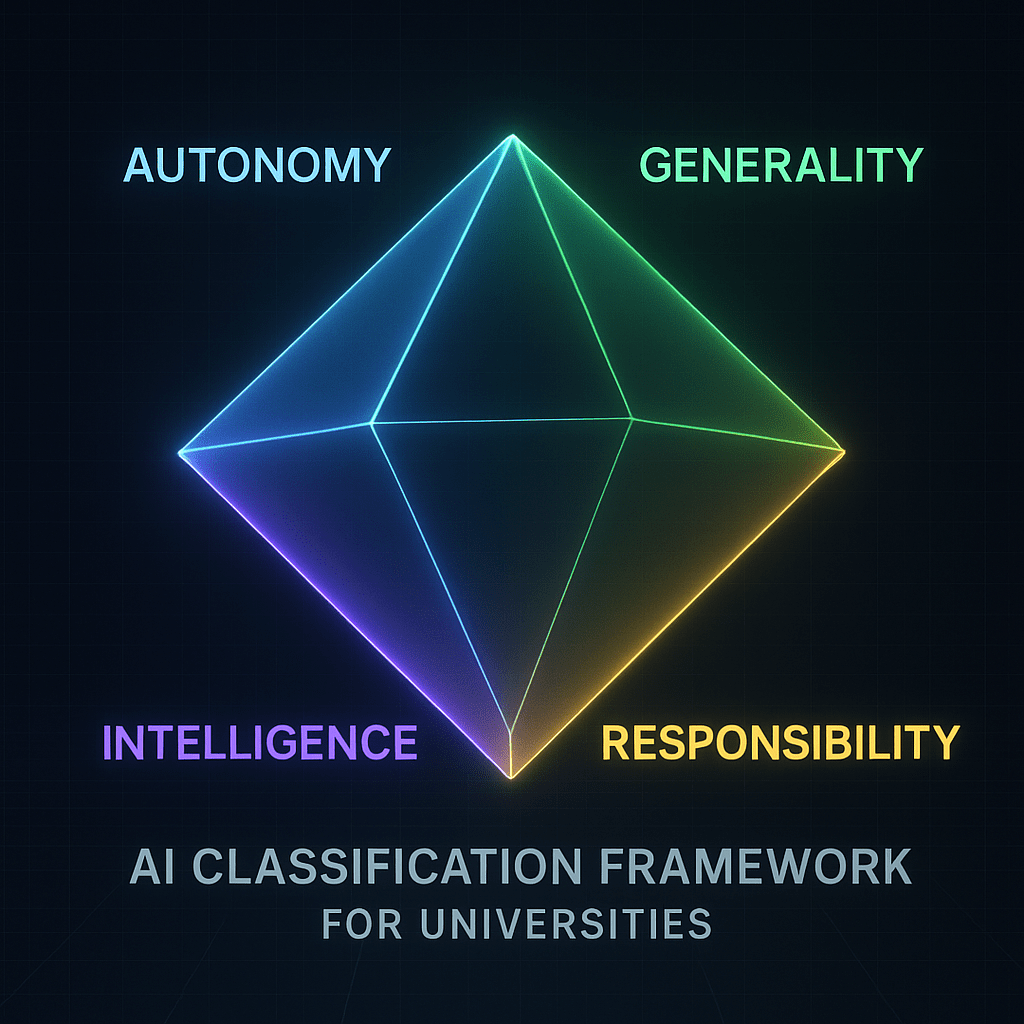
Dr. Stefan Bieletzke of Trainings-Online GmbH presented the RAGI Model at the 18th International EDULearn Conference in Palma (June 2026) — a classification framework for AI systems built on four dimensions:
- R – Responsibility: A meta-dimension capturing institutional governance and ethical oversight
- A – Autonomy: To what extent does the system act independently?
- G – Generality: Is the system task-specific or broadly applicable?
- I – Intelligence: How complex is the system’s cognitive performance?
The three capability dimensions (A, G, I) define a space in which any AI application can be positioned. Responsibility acts as a governance overlay across this space.
Examples from Campus Life
- Room optimization systems combine autonomy and intelligence without generality. They act independently, but within a narrowly defined domain.
- Learning chatbots combine generality and intelligence but lack autonomy. They handle a wide range of questions, but always wait for user input.
These distinctions matter enormously for institutions: a highly autonomous, general intelligent system (AGI) carries different risks than a specialized assistant — and demands correspondingly different governance measures.
Responsibility as a Governing Principle
The RAGI Model explicitly asks whether certain combinations of capability dimensions should be limited on grounds of institutional responsibility — particularly those leading to highly autonomous and general intelligent systems. Campus management systems such as TraiNex today handle examinations, admissions, documents, and communication. As AI becomes more deeply integrated into these processes, a framework like RAGI becomes indispensable for meeting requirements around transparency, traceability, and accountability.
Conclusion
The RAGI Model offers a simple yet extensible dimensional framework that links the technical capabilities of AI systems with their institutional application context. It enables structured comparison across AI applications — and its relevance extends well beyond higher education. For decision-makers at educational institutions, it provides the conceptual foundation to plan AI investments purposefully and deploy them responsibly.