When Stefan Bieletzke and AI specialist Prof. Dr. Manfred Leisenberg recently cycled the route of the Hermannslauf from Detmold via the Hermann Monument all the way to Bielefeld — roughly 31 kilometers through the Teutoburg Forest — they talked about what drives them both: artificial intelligence and its impact on sports. A topic that is no longer the exclusive domain of elite athletes.
The Boom: AI Technology in Sport Is Growing Fast
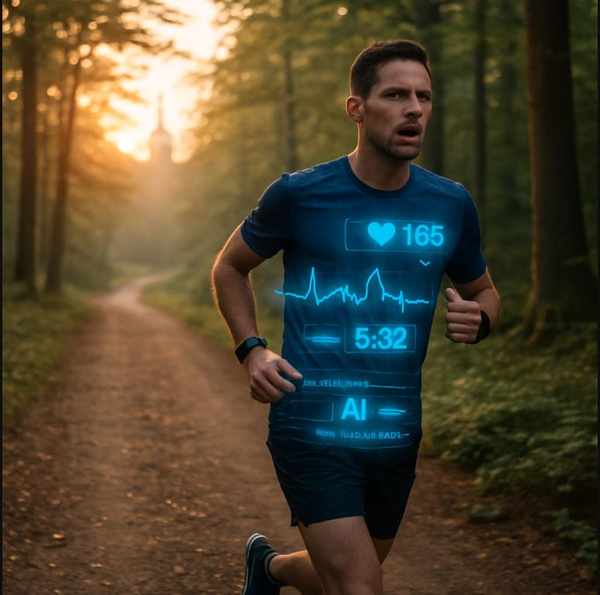
The AI-in-sport market is exploding. According to current studies, it is set to grow to over 27 billion US dollars by 2030 — with an annual growth rate of nearly 29 percent. What is driving this? Smartwatches, GPS trackers, and heart-rate monitors collect enormous amounts of data. AI turns that raw data into actionable insights.
For recreational runners, this means that anyone training with a modern sports watch already has access to rudimentary AI support. The watch recognizes recovery patterns, warns against overtraining, and suggests optimal training intensities. Prof. Dr. Leisenberg — who has completed the Hermannslauf twelve times himself and co-founded the running network uniRenner — sees this as just the beginning.
Injury Prevention Through Pattern Recognition
One of the most promising applications is injury prevention. AI systems analyze gait, load parameters, and recovery data to identify patterns that point to impending overuse injuries — often weeks before the pain sets in. For runners who have spent months building up training plans for a marathon or a demanding trail race like the Hermannslauf, this is a genuine game-changer.
Professional teams in the Bundesliga and international elite sport are already using such systems as standard practice. The democratization of this technology — making it accessible to recreational athletes — is one of the most exciting developments of the coming years.
AI and Higher Education: What Does This Have to Do with Campus Management?
The connection between running and campus management may seem surprising at first glance. But the underlying principles are the same: making sense of data, recognizing patterns, making informed decisions. Campus management systems like TraiNex do exactly this in higher education — from automatically verifying enrollment prerequisites to analyzing learning progress. AI is becoming an indispensable part of that equation too.
Prof. Dr. Leisenberg, who researches and teaches AI at FHM Bielefeld, brings both perspectives together in practice. As a university professor, he knows both worlds — data-driven sport and data-driven higher education. On the cycling route through the Teutoburg Forest, what started as a recreational outing turned into a productive exchange about the future of both fields.
Conclusion: Data Runs Along
AI in running is no longer science fiction — it is embedded in the sports watch on your wrist, the training app on your phone, and the analytics systems of professional clubs. Anyone training today trains with a digital assistant. The question is not whether to use the data, but how well.
And perhaps that is the most important lesson to take away from a 31-kilometer cycling trip through the Teutoburg Forest: technology is no substitute for personal passion — but it can make an excellent companion.